Chaos Whispering in Modern Project Leadership:
The Art of the Subtle Shift
Introduction
In an era defined by rapid shifts and systemic complexity, traditional project management often fails because it attempts to reduce turbulence with rigid controls. Chaos Whispering offers a more sophisticated alternative: the ability to sense, influence, and harmonize with systemic turbulence rather than fighting it. It is the quiet discipline of finding the signal within organisational noise to guide a project toward its goals.
What is Chaos Whispering?
Chaos Whispering is the practice of utilizing empathy, pattern recognition, and subtle interventions to navigate complex transitions. Unlike Chaos Management, which seeks to impose order through force, the ‘Whisperer’ acknowledges that systems are living things. By leaning into the Edge of Chaos—the fertile ground between rigid bureaucracy and total randomness—they identify the small, high-leverage points where a ‘whisper’ (a minor adjustment) can create a massive shift in outcome.
How Can It Be Applied in Project Management?
In project management, this manifests as Adaptive Governance and Leadership. Instead of reacting to a crisis with more meetings and stricter controls, a Chaos Whisperer:
- Identifies ‘Noise’ vs. ‘Chaos’: They distinguish between temporary distractions and systemic threats.
- Uses Contrast: They apply ‘controlled silence’ or lowered volume to regain team focus during high-stress delivery phases.
- Facilitates Transitions: They treat project handovers and go-lives as delicate human transitions, reducing friction through emotional intelligence.
What is Meant by the Chaos Whispering Collective?
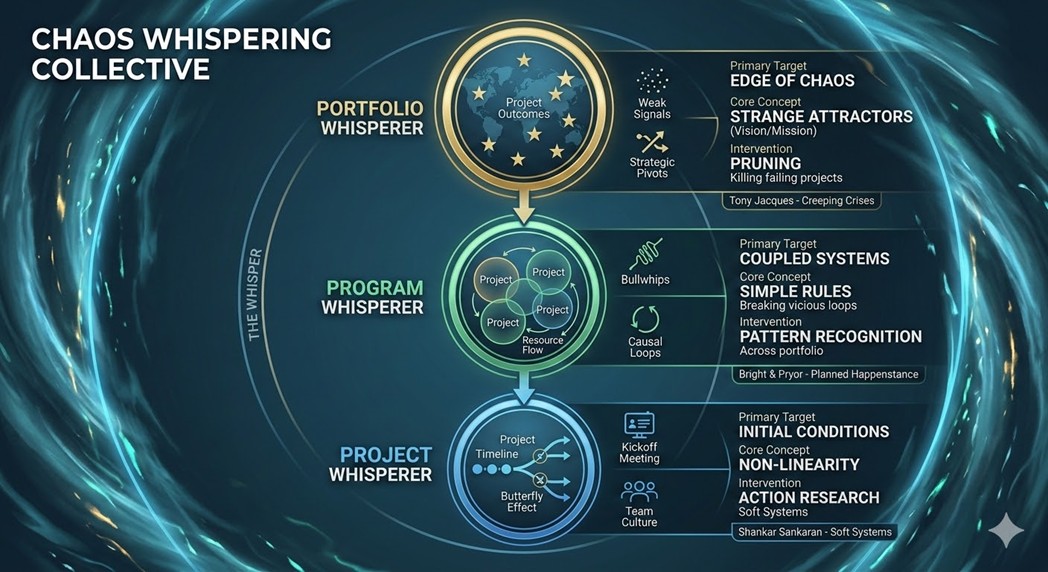
The Chaos Whispering Collective refers to a tiered network of practitioners—leaders, mentors, and organisational psychologists—who share insights on navigating a lack of order or predictability, or a gradual decline into disorder. It suggests that no single person can ‘whisper’ to an entire organisation; rather, it requires a tiered approach to quiet the noise at every level of the hierarchy.
Within this collective, three critical managers operate in harmony to stabilize the system:
- The Project Manager (The Chaos Whisperer): Operates at the ground level, managing the immediate turbulence of daily tasks, team dynamics, and technical roadblocks. They focus on turning ‘noise’ into a ‘signal’ to keep the project on track.
- The Program Manager (The Havoc Whisperer): Manages the havoc created by competing resources and shifting dependencies between multiple projects. They whisper to the broader system managers to ensure that the friction between moving parts doesn’t lead to a total systemic breakdown.
- The Portfolio Manager (The Crisis Whisperer): Operates at the strategic level, identifying the whispers of market shifts (trends) or internal failures (previous catastrophes), before they become full-blown organisational crises. They harmonise the entire investment pipeline with the company’s long-term vision.
Together, this collective ensures that local ‘whispers’ align with the broader corporate resonance, preventing small tremors from becoming catastrophic quakes.
How Does Chaos Whispering Influence Project Leadership?
Chaos Whispering shifts the leadership paradigm from ‘Commander’ to ‘Conductor.’
By remaining calm and using subtle cues, a leader acts as a grounding force. This increases engagement within the team, as members must focus on the leader’s frequency, fostering a culture of deep listening, emotional intelligence, and high adaptability.
- Engagement: Leaders understand that whispering (metaphorically and literally) forces a team to focus by increasing cognitive engagement and understanding.
- Safety and Trust: By remaining calm when the system is volatile, the leader acts as a grounding force, allowing the team to innovate at the ‘edge of chaos’ without falling into panic.
How is it used in Dr. Gough’s Organisational Improvement Model (OP3M)?
Integrating Chaos Whispering into formal corporate structures—like Dr. Gough’s OP3M Model—transforms a seemingly ‘mystical concept’ into a rigorous strategic tool.
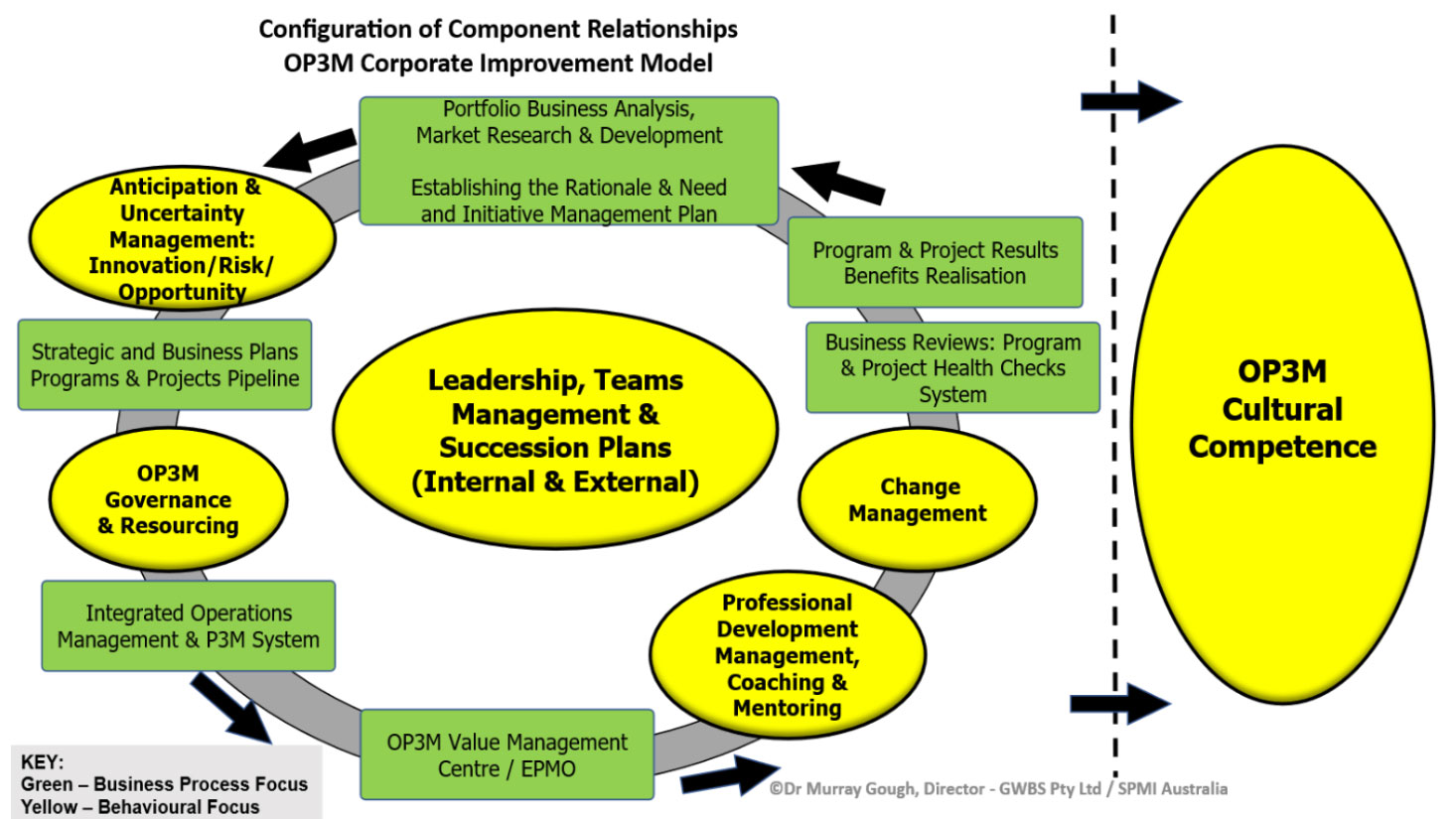
In the OP3M Corporate Improvement Model, Chaos Whispering bridges the gap between Business Process Focus (Green) and Behavioural Focus (Yellow).
- Anticipation & Uncertainty Management: This is the primary home of the Collective. While the Project Manager whispers about immediate risks, the Portfolio Manager (Crisis Whisperer) anticipates macro-uncertainty in the Strategic and Business Plans pipeline.
- Leadership & Succession Plans: The centre of the model emphasizes that leadership isn’t just about Internal management; it’s about the External resonance. The Collective ensures that, as leaders move through the Integrated Operations and P3M System and work with the Value Management Centre/EPMO, they carry the ‘Whispering’ skill set with them.
- Professional Development: It utilizes Mentoring and Coaching to teach practitioners how to listen to the ‘whispers’ of a project’s health checks and stage gate reviews.
- Cultural Competence: The transition from individual project results to organisational competence requires the Program Manager (Havoc Whisperer) to manage the behavioural change across various teams. Chaos Whispering ensures that Change Management and Coaching are not just checkboxes, but instigate authentic behavioural shifts. Chaos Whispering acts as the catalyst that moves the ‘Configuration of Component Relationships’ (Dr. Gough’s model) into the realm of Cultural Competence.
Conclusion
Chaos Whispering is not the absence of order; it is a more sophisticated form of it. By integrating these subtle techniques into frameworks such as the OP3M Model, project leaders can move beyond merely surviving chaos to truly mastering it.
In a loud world, the one who whispers is often the one who is most clearly heard.
Essential Reading & References
-
The Human Element & Emotional Regulation
- Rudolph, J. (2026). Facing chaos by listening to the whispers. A very recent piece on Medium discussing grounding oneself amid societal and personal upheaval. It emphasizes “inner resonance” as a tool for navigating a shifting landscape.
- Storybird. (2023). The whisper of chaos. https://storybird.com/chapters/the-whisper-of-chaos/. While presented as a narrative about a “God of Entropy,” this serves as a powerful metaphor for how small, whispered changes (influence) can disrupt or restore complex systems more effectively than brute force.
- SUZAN_31. (2025). Whispers in the chaos: Managing the student mind. Focuses on the internal “noise” of high-pressure environments (like academia) and the importance of that small inner voice that helps one “hold on” during burnout.
-
Practical Frameworks & Case Studies
- Weisshappel, S. (2024). Confessions of a chaos whisperer. A cornerstone reference for this module. Weisshappel applies “chaos whispering” to physical and life transitions (moving, downsizing, loss), showing how empathy and practical systems create order in disorderly moments.
- “I can hear just fine”: The psychology of controlled silence. (2025). An analysis of the viral trend where leaders/creators use a whisper to regain control in loud, chaotic environments. It highlights the power of extreme contrast and setting boundaries without aggression.
-
Theoretical & Scientific Foundations
- Auditory Chaos Classification (Frontiers in Digital Health, 2023): A technical look at how we measure “household chaos” through sound. It differentiates between simple volume and the “complexity” of noise—highly relevant if your module touches on environmental design.
- Kumai, T. (2022/2023). The edge of chaos in learning. Discusses the “Edge of Chaos” as the optimal state for growth and language acquisition. It posits that total order is boring and total chaos is confusing, but the “whisper” of the edge is where peak adaptability occurs.
- “Whispering: The Hidden Side of Auditory Communication” (PubMed): Research on how the brain processes whispered voices differently, requiring more cognitive “neural compensation.” This supports the idea that “whispering” in a chaotic system forces others to lean in and engage more deeply
Here are the key Australian voices in this field:
-
Professor Shankar Sankaran (University of Technology Sydney)
Sankaran is arguably Australia’s leading authority on Organisational Project Management (OPM) and systems thinking.
- Key Concept: He advocates for “Action Research” in complex projects—essentially, “learning by doing” while the project is in motion.
- Study: Systems Thinking: Taming Complexity in Project Management (2012). This study explores how project managers can use “soft systems methodology” to map out human and social complexity, rather than just technical schedules.
- The “Whisper”: Sankaran emphasizes that project managers are often managing “meanings and politics” rather than just tasks.
- Robert G. L. Pryor and Jim E. H. Bright
While they come from a vocational and career background, their “Chaos Theory of Careers” (CTC) is widely used in Australian management training to explain how individuals navigate chaotic workplaces.
- Key Concept: They focus on “Planned Happenstance”—the idea that since you can’t predict every variable, your job as a leader is to create the conditions where “lucky breaks” can be exploited.
- Key Work: The Chaos Theory of Careers (2011).
- The “Whisper”: They suggest moving away from “matching people to jobs” toward “building resilience for change.”
- Dr. Tony Jacques
Based in Melbourne, Jacques specializes in Issue and Crisis Management through the lens of non-linear systems.
- Key Concept: He identifies the “Pre-Crisis Phase” as a period of “creeping crises”—small, chaotic signals that managers often ignore until they cascade.
- Key Work: Crisis Proofing: How to Anticipate, Prevent and Manage Crisis (2014).
- The “Whisper”: His work is essential for the “Crisis Whisperer” (Portfolio level), focusing on identifying “weak signals” before they reach the “Butterfly Effect” tipping point.
- Professor Timothy Pitsis
Pitsis has done significant work on “Governing Projects under Complexity” and “Future Proofing” projects.
- Key Concept: He explores how governance in complex projects must be “enabling” rather than “coercive.”
- Study: Governing projects under complexity: theory and practice in project management (2014).
- The “Whisper”: He argues that for complex projects, the best “control” is a clear, shared vision—the ultimate Strange Attractor.
A Call to Action: Join the Chaos Whispering Collective
The modern corporate landscape is no longer a predictable machine; it is a living, breathing ecosystem of shifting priorities and high-velocity change. To thrive within Dr. Gough’s OP3M Corporate Improvement Model, we must move beyond the era of loud, rigid command-and-control and enter the era of the Whisperer.
Whether you are a Project Manager quieting the daily chaos, a Program Manager harmonizing systemic havoc, or a Portfolio Manager pre-empting a strategic crisis, your role is vital to the organisation’s collective resonance.
How to Step Into the Circle:
Audit Your Influence: Identify one “noisy” area in your current project or program. Instead of adding more process (Green), identify the behavioural “whisper” (Yellow) that could shift the team’s energy.
Adopt the OP3M Mindset: Review the Anticipation & Uncertainty Management quadrant. Are you reacting to the storm, or are you sensing the subtle atmospheric shifts before they break?
Contribute to the Collective: Share your “Whispering” case studies. The Collective thrives on shared intelligence—the more we document the subtle shifts that led to major successes, the more competent our organisational culture becomes.
Practice “Leaning In”: In your next high-stakes meeting, experiment with the power of the lowered volume. Force the system to quiet itself to hear the direction of the lead.
The Whisper Starts With You
True Cultural Competence is not a destination; it is a frequency. By joining the Chaos Whispering Collective, you are committing to a higher standard of leadership—one that values empathy as much as efficiency and intuition as much as integration.
Don’t just manage the chaos. Whisper to it.
🛡️ Join the Collective: SPMI Learning Module
Ready to find the signal in the noise? Transition from managing chaos to mastering it. Your journey into the deeper mechanics of the OP3M Corporate Improvement Model continues at Strategic Project Management International (SPMI).
👉 Access the SPMI Chaos Whispering Module Here