Corporate Project Management Improvement Model
Guide for Executive Business Managers
This guide was developed following the completion of an Applied Doctoral Thesis presented to the University of Southern Queensland in 2022. The thesis topic was “Corporate Improvement in Project Management: A design thinking approach investigating an adaptable model.”
Purpose of this Guide: This guide provides a brief overview of the improvement model and is an avenue for reflection and potential application in YOUR organisation.
Purpose of the Study. The purpose of the study was to create a business benefits model for project management that can be adapted and applied to ANY organisation.
Methodology. The study applied a global approach in addressing the topic, initially undertaking an extensive international literature review of portfolio, program, and project management (P3M). The main themes from these findings were then assessed through two quantitative surveys, with a range of AIPM-, IPMA-, and PMI-qualified practitioners commenting on their applicability to organisations seeking to improve P3M. As the components of a model emerged, a thematic analysis of interviews with P3M experts and leaders resulted in a prototype improvement model that was then evaluated using five case studies from Australia, Malaysia and Sri Lanka. These analyses resulted in two models for improvement: one for organisations less developed in P3M and the other for organisations with an existing P3M system.
Final Result. The final result was a combined adaptable model focusing on behaviours, attitudes, and leadership rather than methodological or process improvement for organisational portfolio, program, and project management (OP3M).
What is OP3M?
OP3M is the systematic management of portfolios, programs, and projects aligned with achieving strategic goals and measured through business results. It is a discipline that culminates in a corporate cultural approach aligned with business processes. It is an integrated system that is not considered separate from business management. In summary, an OP3M system provides benefits that:
- strengthens the link between strategic planning, execution, and results
- allows project outcomes to become predictable, dependable, consistent, and correlate with organisational success
- identifies the best practices that support the implementation of corporate strategy through successful programs and projects
- identifies the specific capabilities that make up best practices
- includes best practices and capabilities for P3M
- provides a means to assess an organisation’s maturity at prescribed levels
- provides a system that is flexible in its application to each organisation’s context and needs
- is based on P3M competency standards recognised nationally and internationally
- draws on the expertise of a wide range of practitioners and consultants across industry
- provides a comprehensive body of knowledge and expertise in P3M for the organisation and its industry segment.
How to improve an organisation that does not have a P3M system?
Organisations with little or no P3M system have initiatives/projects that are poorly performing or not achieving their potential. The first step towards improvement is awareness. Managers must acknowledge that a systematic approach to P3M will benefit them and the organisation. Diagrammatically, Figure 1 outlines a path to progress.
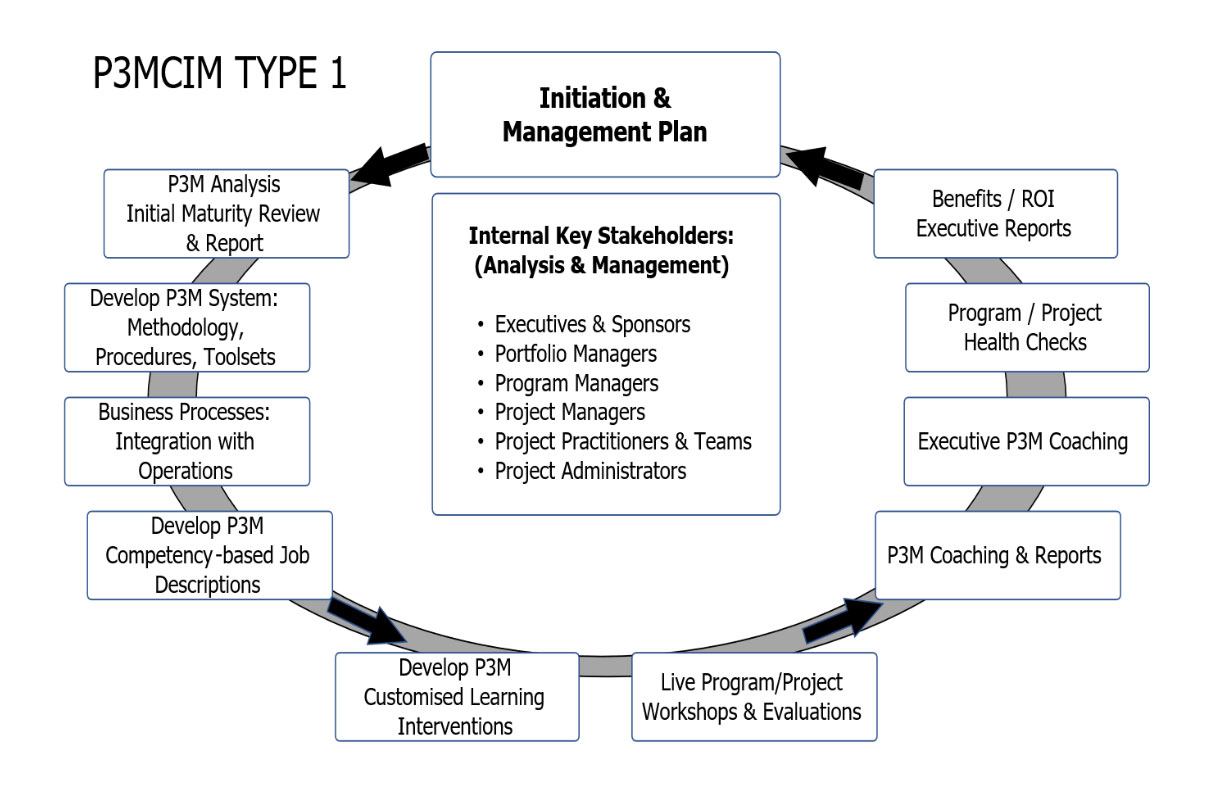
Note that internal stakeholders (in the central section) drive the approach. Establishing an “Initiation & Management Plan” motivates change and its measurement. It provides a “sign-on” for critical stakeholders. The plan also enables managers to select those components in the model to prioritise that will provide immediate/short-term return on investment for the organisation, noting that all components require attention over time.
How to improve an organisation that has a P3M system?
Organisations that already have a form of P3M system have a sound project management approach, but have not integrated with portfolios, programs, and business systems, and have no immediate or longitudinal evaluation of business results.
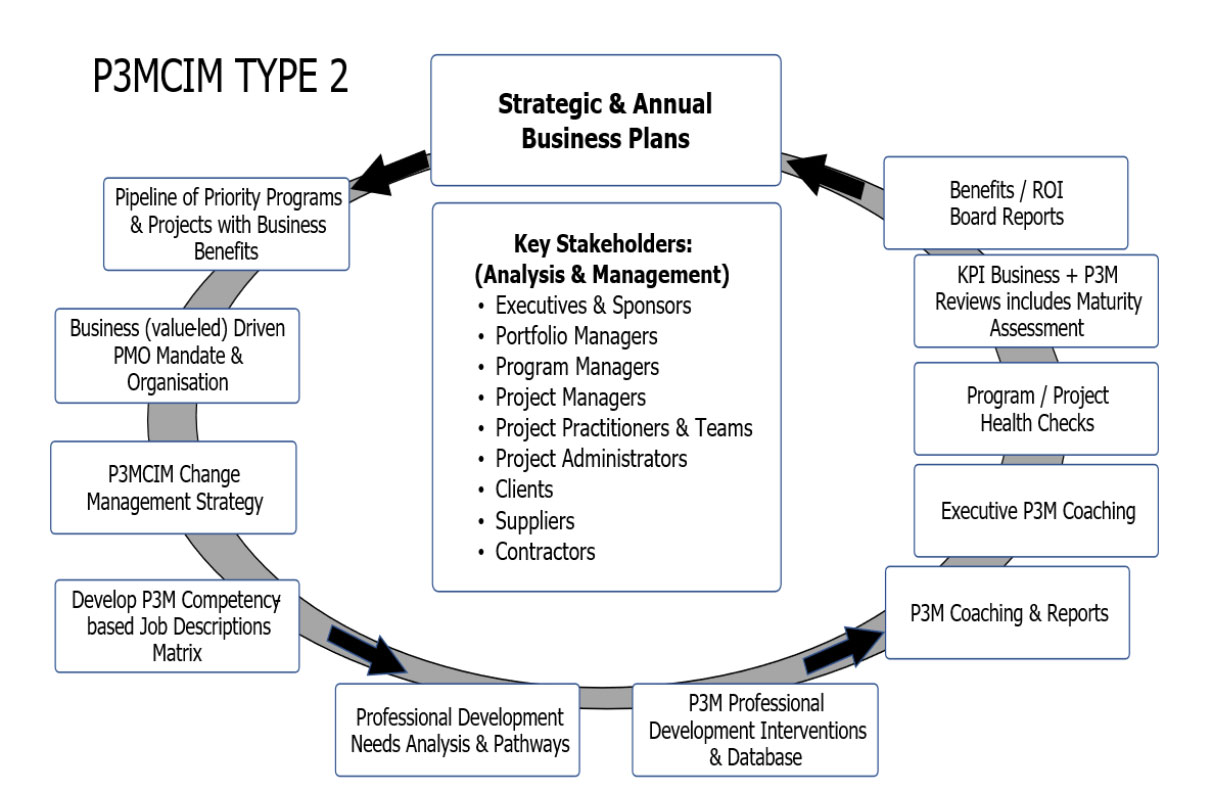
Note that internal and external stakeholders (central section) drive this Type 2 approach. As with Type 1, establishing an “Initiation & Management Plan” motivates change and its measurement. It provides a “sign-on” by critical stakeholders. In this case, planning is more extensive than Type 1, as it focuses on the “reason to exist” of the organisation and its strategic and annual business planning. The plan also enables managers to select those components in the model to prioritise that will provide immediate return on investment for the organisation, noting that all components require attention over time.
What are the unifying OP3M Components?
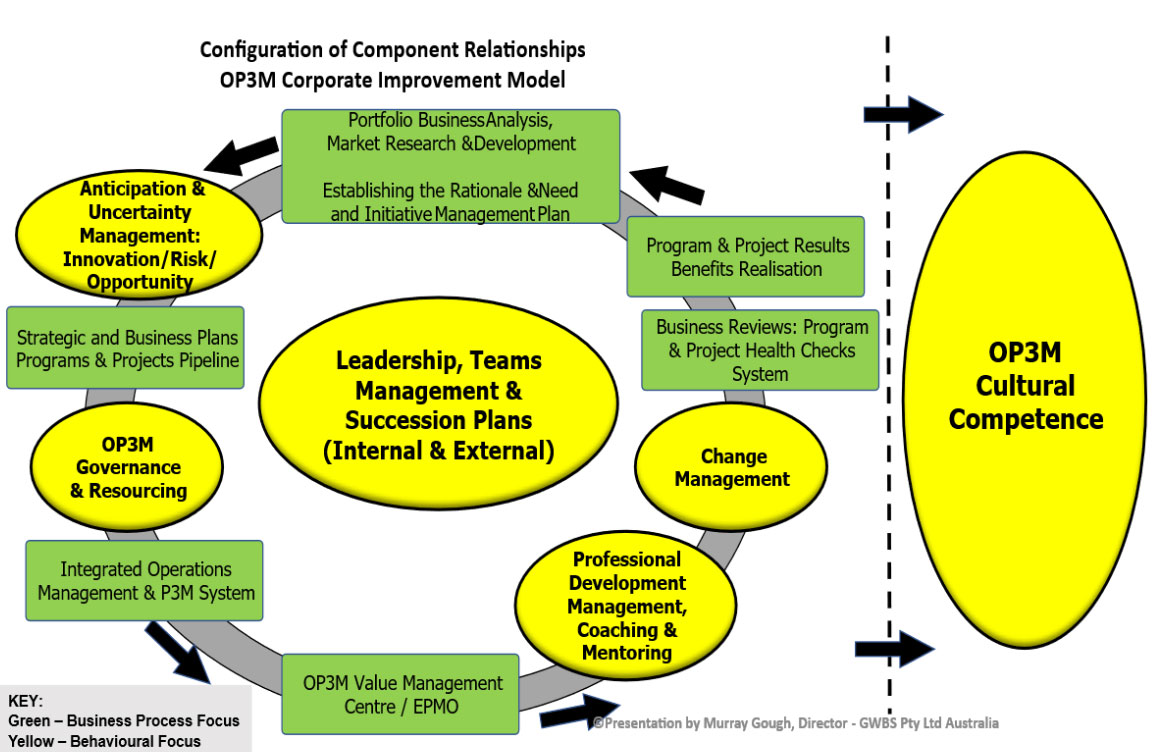
Note that the approach is driven by stakeholder leadership and teams and supported by succession planning and management (central section).
How does a combined model work?
Components are organised in an anticlockwise direction, beginning with establishing the rationale and need for improvement. Each component has an outcome: a solution, a remedy, or a related action. The loop is eventually closed by examining Program & Project Results and Benefits Realisation, which feed back to the organisation’s future Strategic and Business Plans. The sum effect of the model results in P3M Cultural Competence (far right oval).
Note that the configuration of relationships indicates differences between the components: rectangles (green) for relatively standard business processes, and ovals (yellow) with bold text for those that rely heavily on behavioural conditions. As a result, the model emphasises behavioural change rather than a business process or methodological change.
The model does not need to be used or commenced following the above sequence. For example, a likely investigation of the organisation’s needs may be identified through project health checks. A subsequent report may indicate P3M weaknesses requiring improvement. Priority action may also arise due to information from the Value Management Centre/EPMO that pinpoints areas of concern in planning or implementation. Alternatively, the model may begin with professional development interventions that alert managers to P3M issues and responsibilities. In this case, the model is not the starting point for examining problem areas. The areas for concern may well be those identified through, for example, poor business results or a lack of professional development at the managerial level.
The model merely provides a linked series of components for systemic examination and elements to enable improvement. The choice and application of the components must suit the organisational context and be of corporate value.
What other factors should be considered?
Simply applying a model for organisational improvement in P3M is, in reality, a starting point. In any organisation, overlays of knowledge, understanding, and competency underpin productive organisational maturity. The following topics exemplify where managers need to direct professional development to assist in embedding organisational cultural change in P3M:
- Market research, analysis, and organisational positioning
- Anticipation analysis and management in respect of local, national, and international affairs (see UNESCO 2020)
- Innovation development and management
- Business Uncertainty analysis and management
- Professional development strategies and programs (internal and external); exploring cognitive and affective domain learning
- Business improvement and change management (integrating P3M)
- Business reviews linked to P3M maturity levels
- Program and project health check systems (customisation)
- P3M-related information technology, customisation, and competency
- P3M Business benefits analysis and management
- P3M and Business Leadership strategies, especially with virtual teams and multiple generations/cultures
- Psychometrics selection, analysis, and management for P3M managers
- Workforce Multi-generational identification, analysis, and management
- Research and development in P3M case studies (industry-specific)
- Embedding organisational change and improvement strategies
- OP3M Governance and Resourcing
- Developing expertise in P3M recruitment, development pathways, retention, succession planning, and management
- Future-proofing the organisation to reflect the potential market, social, political, and economic change
- OP3M Cultural Competence: development and practice
Conclusion
Use these notes (overleaf) to reflect on and consider your organisation’s position and needs, and draft comments for corporate discussions.
MY RESPONSE
Where is my organisation situated with OP3M? What are our needs? What are our priorities?
What should my role be?
What is our Action Plan?
Do we need external consultative assistance?
🛡️ Need Assistance from SPMI? Visit our website.
Consider accessing our Workplace Learning Modules. A deeper journey into the mechanics of the OP3M Corporate Improvement Model continues at Strategic Project Management International (SPMI).